Technology

MyotonPRO Digital Palpation Device

MyotonPRO offers a non-invasive, reliable and accurate solution for digital palpation of soft biological tissues. The device measures superficial skeletal muscles, tendons, ligaments, adipose tissue and skin.

MyotonPRO is a hand-held, smartphone-sized device which is quick and easy to use. Scientific research has proven its practicality and versatility.

The current MyotonPRO model is designed for research use only.

Method of measurement

Inspired by nature, Myoton implements a “tap and listen” method – a key technique used by wildlife for locating food, navigation and communication.

Therefore, Myoton employs a measurement method defined as the Mechanical Dynamic Response method.

The method consists of a mechanical precision impulse, the recording of dynamic tissue response in the form of physical displacement and oscillation acceleration signal and the subsequent computation of parameters characterizing the State of Tension, Biomechanical and Viscoelastic properties.


Five parameters for science

To build a strong scientific background, Myoton encourages researchers to analyze all five parameters for reliability and validity.

Acceleration Time max a max a 1 a 3 t 1 t R t 1 t T

Oscillation Frequency [Hz] characterizes the intrinsic tension of biological soft tissues on the cellular level.

Oscillation Frequency characterizes the tone of superficial skeletal muscles in their passive or resting state without voluntary contraction (EMG signal silent).

The Oscillation Frequency of a muscle in its contracted state characterizes state of tension.


Dynamic Stiffness [N/m] characterizes the resistance of biological soft tissues to a force of deformation.

The term Dynamic Stiffness originates from the dynamic measurement method applied in Myoton technology. The inverse of stiffness is compliance.

Logarithmic Decrement [relative unit] characterizes the dampening of tissue oscillation.

The faster the tissue oscillation fades, the higher the dissipation of mechanical energy induced by the measurement impulse.

The decrement of natural tissue oscillation serves as an inverse indicator of elastic behavior, where a higher decrement corresponds to lower elasticity.

A decrement of zero is associated with ideal elasticity: no energy is lost during oscillation, and the tissue would theoretically continue oscillating after the measurement impulse, indicating a purely elastic response without damping.

Elasticity is a biomechanical property of soft tissues that describes their ability to recover their original shape after deformation. The opposite of elasticity is plasticity.

Note: Although decrement and elasticity are related, they are not equivalent parameters. Decrement should therefore not be interpreted as a direct measure of elasticity.

Mechanical Stress Relaxation Time [ms] characterizes tissue’s recovery time from displacement.

The higher a tissue’s tension or stiffness, the faster a tissue recovers its shape, meaning the lower the value.

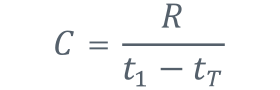
Ratio of Relaxation and Deformation time [relative unit] characterizes creep, the gradual elongation of tissue over time when placed under constant tensile stress.

The higher a tissue’s tension, structural integrity, or stiffness, the higher its resistance to creep, meaning the lower the value.

What can be measured?

Limitations

Myoton technology in a standard configuration cannot be used for the measurement of:

  • Muscle groups, as it is intended for single muscles
  • Thin Muscles (< 3mm)
  • Muscles with small mass (< 20 g)
  • Un-palpable muscles
  • Deep muscles located under layers of other tissues
  • Muscles covered by subcutaneous fat (>20mm)
  • Tissues that are not categorized as soft biological tissue
See possible applications