


Publications
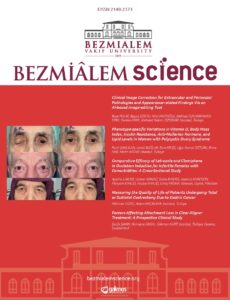
Investigation of the Viscoelastic Properties of Selected Upper Extremity and Cervical Muscles and Movement-based Reaction Time in University Students with Smartphone Addiction
Authors: Engin Ramazanoglu 1, Sinemhan Gulis 2, Melek Yildirim 2, Berke Han Celik 2, Irem Balicok 2, Naciye Dilruba Tektas Gulbil 3
Affiliations:
- Mardin Artuklu University Faculty of Health Sciences, Department of Physiotherapy and Rehabilitation, Mardin, Turkiye
- SANKO University Faculty of Health Sciences, Department of Physiotherapy and Rehabilitation, Gaziantep, Turkiye
- Istanbul Beykent University Faculty of Health Sciences, Department of Physiotherapy and Rehabilitation, Istanbul, Turkiye
Journal: Bezmialem Science - August 2026, Volume 14, Issue 3, Pages 245-255 (DOI: 10.14235/bas.galenos.2026.01488)
-
Field & Applications:
- Medical
- Balance / Postural control
- Musculoskeletal health
Objective: The aim of this study was to evaluate the relationship between smartphone addiction and the viscoelastic properties (tone, stiffness, elasticity) of selected upper extremity and cervical muscles and movement-based reaction time in university students.
Methods: This cross-sectional study included 216 university students. Participants were divided into addicted and non-addicted groups using the Smartphone Addiction Scale-Short Version (cut-off score: males ≥31, females ≥33). Muscle viscoelastic properties were assessed using the MyotonPRO device, and movement-based reaction time was evaluated via the SWAY application.
Results: Mostly low-level but significant positive correlations were found between muscle viscoelastic properties, screen time, and SWAY average scores. Moderate correlations were observed between some parameters of the flexor carpi ulnaris and extensor carpi radialis muscles and both the SWAY average and daily screen time.
Conclusion: Smartphone addiction was associated with changes in selected muscle viscoelastic properties, while only weak associations with movement-based reaction time were observed. These findings suggest that excessive smartphone use may be related to minimal neuromuscular adaptations rather than clinically definitive impairments.
Keywords: muscle viscoelasticity, reaction time, smartphone addiction, university students
This study demonstrated that smartphone addiction was associated with selected changes in muscle viscoelastic properties. Weak associations were also observed between certain muscle viscoelastic parameters and movement-based reaction time. Because of the cross-sectional design, these findings should be interpreted as associative rather than causal. Further longitudinal studies are required to clarify whether these biomechanical alterations have clinically meaningful consequences.